Public Layer

How we help

Whatever your organisation does, part of your people’s week goes to work that comes round again and again. Here’s how we give that time back, and what it turns into.

Your three biggest pieces of recurring work, running in 90 days

Most organisations have handed staff an AI tool and left them to work it out. It doesn’t know your format, your standards or your rules, so every draft needs rewriting.

We set it up for the work itself. You pick the three pieces of recurring work that take the most of your team’s time, and we set each one up from two or three of your best past examples, inside the AI your team already uses. Your people paste in their notes and get back a draft that reads like your organisation wrote it, ready to check and send. The first is working on real work in about three weeks, and all three within 90 days.

How you’ll know it worked. Before we start, we agree what the freed time is for: more billable work, more people supported, an outside cost you can stop. At day 90 you get that number in dollars, from your own records.

After 90 days, it keeps improving. Your team brings in new work as they need to, with no limit on how many people use it. Every month we check that each one still works, keep the rules it relies on current, and fix anything the AI’s own updates break. Every quarter you see what the freed time turned into.

Underneath it all, everything draws on one shared picture of your organisation: who you are, who you serve and how you sound. That’s why the second and third pieces of work come faster than the first, and why the quality holds.

Where most organisations start

  • Accounting and advisory firms: client meeting briefs and follow-up emails, information request lists, first drafts of advice letters.
  • Consulting firms: proposals and statements of work from discovery notes, status reports, steering committee papers.
  • IT service providers and IT consultancies: monthly client service reports from a ticket export, proposals and statements of work, security policies tailored to each client.
  • Councils and government agencies: briefs and committee reports, replies to community enquiries, policy updates when legislation changes.
  • Associations and peak bodies: board papers and committee briefs, answers to member enquiries, submissions to government.
  • Charities and community organisations: grant applications, acquittals and funder reports, donor and impact updates.
  • NDIS, aged care and allied health providers: quotes and service agreements checked against the rules, incident report drafts for a manager to finalise, reports and letters to referrers.
  • Trades, property and planning: quotes and scopes of work from site notes, safe work method statements, development application cover letters and replies to requests for more information.
  • Education and training providers: compliance evidence against the standards, course descriptions, letters to students and parents.
Know whether it fits the rules before you commit

Some questions come up every week, and the answer waits on the one person who knows the rules. Can this site take that building? Can we claim this, and at what price limit? Until they’re free, the work stops.

Our rules-checking tools answer from the rulebook itself, in plain words, so your expert checks an answer instead of hunting for one. Every answer quotes the rule it rests on. Anything the tool hasn’t been given is refused, not guessed. A person signs off before anything is used.

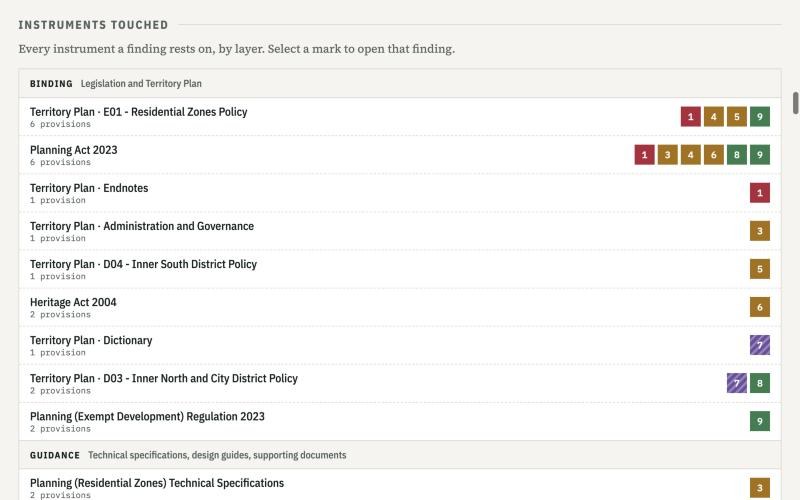
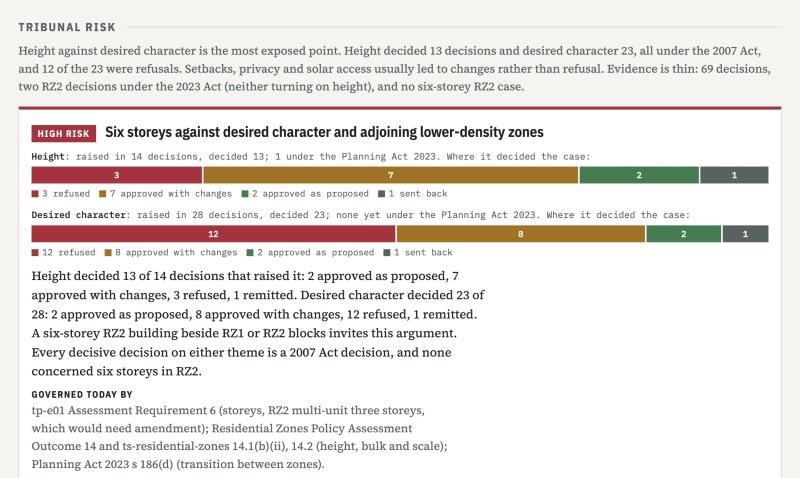
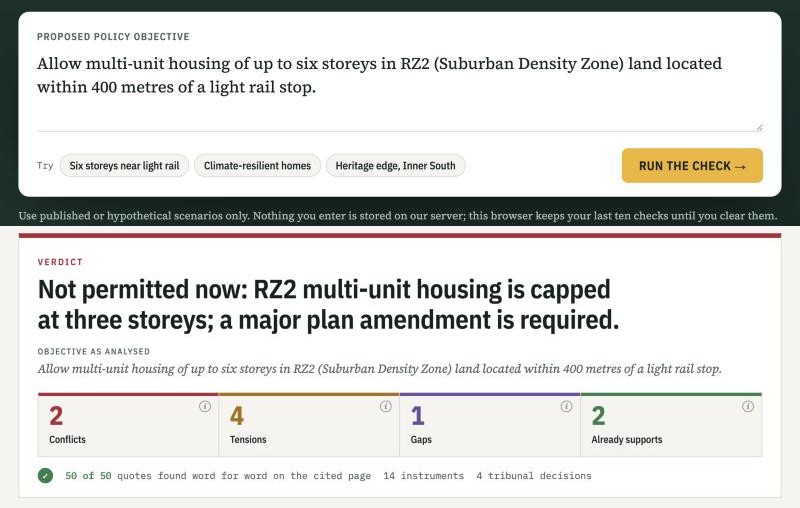
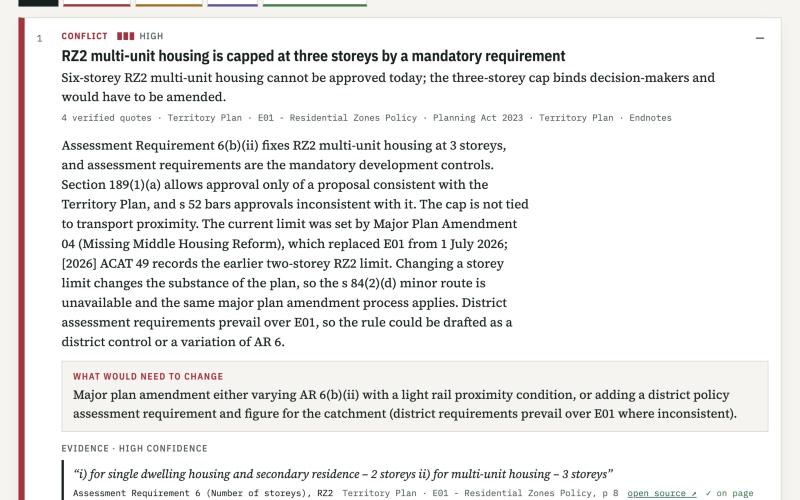
The ACT planning checker: the question asked, then the report’s verdict and counts
The ACT planning checker: findingThe ACT planning checker: instrumentsThe ACT planning checker: tribunal

ACT planning checker

Describe a proposed planning change, such as six-storey housing near light rail. It reports where that runs into the Planning Act, the Territory Plan and the National Capital Plan, what would need to change, and how similar matters have fared at the tribunal.

Built from the ACT’s public planning documents, and we’re testing it with planning professionals now. Its reports are reviewed drafts, not legal advice.

NDIS claiming checker

Describe the support and the participant’s plan. It reports whether it can be claimed, under which item, at what price limit, and what evidence the claim needs, citing the Pricing Arrangements line by line.

We’re testing it with providers now.

Your rulebook next. If your sector runs on a body of rules many organisations share, tell us which one.

Grant applications that pass the assessor’s test

What you want from a grant application is the grant. Every hour your team spends wrestling the guidelines is an hour not spent on the work the grant is for. So everything we do is aimed at giving your application the strongest chance of being funded, with less of your team’s time.

We call it Assessor Ready. That’s the test every application has to pass before it goes in: will the person scoring it find everything they’re looking for?

  1. Read the guidelines line by line. Every criterion, eligibility rule and attachment the funder asks for goes on one list, so nothing slips through.
  2. Answer each criterion in the funder’s own words. Your evidence sits against the criterion it proves, in the terms the assessor is scoring on.
  3. Score the draft the way an assessor will. We mark it against the funder’s own criteria before you submit, and fix anything left unanswered or unsupported.
  4. Keep the evidence for next time. Your outcomes, figures and past applications are organised, so the next application starts from what you’ve already proved.

A funder asks the same four questions any stranger does: is this for us, what does it get us, why should we believe it, and what happens next. Assessor Ready makes sure your application answers all four.

We can write the application with you, or set your team up to run all four steps themselves.

What changes: no one can promise a funder’s decision. Assessor Ready makes sure your application isn’t lost on anything you could have controlled. Your past applications become the starting point for every round after, so the second application starts further along than the first.

Be the answer when someone asks for help in their own words

Right now someone is typing your problem into Google or ChatGPT, in their own words. If your website describes your work only in your sector’s words, they get sent somewhere else. In the paper’s test of 84 organisations, asked in people’s own words, ChatGPT recommended the organisation set up to help first only about a third of the time.

We find the words the people you serve actually use, starting with whoever answers your phone. Then we rewrite your website so the first page each kind of visitor lands on answers their four questions in those words: is this for someone like me, what does it get me, why should I believe it, and what do I do next. We check what Google and AI assistants say about you before we start and after we finish.

What changes: the parent, the carer or the business owner with the problem you solve finds you, recognises themselves on the first page, and knows what to do next.

One motor trades association in the test was recommended first when ChatGPT was asked for its own directory of repairers who follow a code of conduct. Asked “How do I find a mechanic I can trust?”, the way a car owner asks, it didn’t come up at all. The fix is to say both.

Questions people ask before they hire us

Before you start, whatever we do for you

Who do you work with?
Organisations of about 20 to 200 people, in any sector, that do the same kinds of work again and again or run on a body of rules.
Is this for one person or the whole team?
The whole team. Whatever we set up is used by everyone who does that work, in the same words and against the same rules. We start with the person who does it now, because they know what good looks like and they’re the one who shows the rest of the team it works.
How is it priced?
A fixed price, agreed before we start, covers the first three months, while your top three pieces of recurring work go live. From month four, a monthly fee keeps everything working and improving, with no limit on how many people use it. No hourly rates and nothing charged per person. Grant applications are a fixed fee each.
What happens to our information?
Your recurring work runs inside the AI and storage your organisation already uses, so your content stays in your own environment. Our rules-checking tools run in Sydney, with every organisation’s data kept separate. Nothing from one organisation is used for another, and we’ll put that in writing. For NDIS providers, participant information is de-identified before it reaches any AI tool.
What AI do we need?
Claude works today. If your team uses ChatGPT or Copilot, we test it on one piece of your real work before we agree anything.
Do you work with our competitors?
Sometimes, in the same sector. If it’s a question for you, we tell you before we start.

Your recurring work

What counts as recurring work?
Anything your team produces again and again in the same shape: the monthly board paper, client engagement letters, a service quote, the weekly member update. If it comes round at least monthly and someone can say roughly how long it takes, it’s a candidate.
How long until we see something?
The first piece of work is running in about three weeks, and all three within 90 days.
How much of our team’s time does it take?
An hour at the start to agree what to build and what the freed time is for. After that, the people who do the work now use it on real work, which is time they’d spend on that work anyway, plus training on your own examples.
How will we know it worked?
At day 90 you see what the freed time turned into, in dollars, from your own records: billed work, people supported, outside costs that stopped.
Can our team build their own?
Yes, and we want them to. They start from our templates, and we bring each one up to standard at the quarterly review.

The rules-checking tools

How do we know the answer is right?
Every answer quotes the rule it rests on and links to it, so the person who signs off checks a citation instead of searching for one. If the rule isn’t loaded, the tool says so and refuses to guess.
Is this legal or professional advice?
No. It’s a reviewed draft for the person who gives that advice, with the rules it relied on shown in full.
Can we load our own rules as well?
Yes. The shared rulebook stays shared; your own policies, deed or procedures sit in a private layer that only your organisation uses.

Grant applications

Can grant money pay for writing the grant application?
Usually not. Under Commonwealth guidelines the cost of preparing the application itself is ineligible, so that comes from your own funds. Some grants do fund the work the application is for, and that can include tools your team uses; whether yours does is in the guidelines, which we read line by line.
Will you write it, or train us to?
Either. We can write the application with you, or set your team up to run all four steps themselves. Your past applications become the starting point for every round after.
Can you promise the grant?
No one can. What we promise is that the application isn’t lost on anything you could have controlled.

How we work, and why

Start with the work, not the tool.

Buying AI is a workflow decision, not a technology one. The question is where your people lose hours to work the right set-up could carry.

Build it from your own best examples.

A general AI tool leaves your people to work out what to ask and whether the answer’s any good. Set up for one piece of work, it already knows your format, your standards and your rules. A licence is a pantry full of ingredients; what changes a team’s week is the meal kit.

Count what the time becomes.

Hours saved are a measure. What they turn into, in your budget holder’s own terms, is the result.

A person stays in charge.

Your team signs off anything drafted in your organisation’s name, and public-facing tools show their sources.

The rules are built in.

The method maps to the six practices in the Australian Government’s Guidance for AI Adoption, and we flag anything near the new privacy transparency line before it’s built.

Make sure it sticks.

Training on your own work, a named owner for each piece, and a check at 90 days. If something isn’t working at 90 days, we work out why with you and fix what’s ours to fix.

Size it to the team that runs it.

Five of the ten leaders in the paper raised resourcing, and several run small teams. Something your team can keep current does more than something big nobody maintains.

Book a free 30-minute call about where your team’s hours go

  1. Tell us a little about your organisation below, and Gary will get back to you to set a time.
  2. On the call, Gary asks what your team writes again and again, what everyone dreads, and what you’d do with the time if you had it back.
  3. After the call, you get a one-page map: the five pieces of recurring work taking the most time, the one we’d start with, and what getting those hours back could be worth to you.

The map is yours to keep, whether or not we ever work together.

Gary reads every message. Privacy